
Restraint and Drama: A Willow Glen Whole-Home Remodel
Updated: Sep 12

Some homes are defined by a neutral palette done beautifully. This one is defined by the moment you decide to commit to color. This Willow Glen whole-home remodel is a study in what happens when a San Jose interior designer stops playing it safe and lets a single, recurring hue do the heavy lifting across an entire home.
The result is a home that feels layered, intentional, and unmistakably alive. From the jewel-toned primary shower to the forest green appliance garage and laundry cabinetry, a confident green moves through each space like a quiet signature. It never shouts. It never overwhelms. It simply shows up, again and again, in the places you least expect it, and makes the whole house feel designed rather than assembled.
This is what distinguishes great interior design projects from good ones: not the budget, not the square footage, but the clarity of vision carried through from the first decision to the last detail.
Why Willow Glen Was the Perfect Canvas for This Design

Willow Glen is one of San Jose's most beloved neighborhoods. Tree-lined streets, craftsman bungalows, a walkable village center, and a genuine sense of community character make it a place where homeowners invest deeply in their spaces. It is the kind of neighborhood where a home's interior can honor its surroundings while still feeling thoroughly suited to modern living.
This project leaned into exactly that tension. The architecture of the home carried warmth and character from the start, including a graceful arched pass-through between the kitchen and dining room that became one of the most photographed details of the finished space. Rather than strip the home of its personality in pursuit of a cleaner aesthetic, the interior design choices were made to amplify what was already there. This is the kind of collaboration between a designer and a space that produces something genuinely wonderful, where the architecture and the design vision push each other forward rather than compete.
Pro tip: Architectural details like arched openings and original moldings are almost always worth preserving. They give new finishes something to respond to, and they are far more expensive to recreate than to keep.
How the Material Palette Was Built to Last
Starting With Stone and Natural Materials

Every decision in this home traces back to one material: Le Blanc polished quartzite. Running continuously from the kitchen countertops and backsplash through every bathroom vanity, bench top, and pony wall cap, this single stone choice is the connective tissue that makes a multi-room renovation feel like one cohesive home rather than a series of separate projects.
Le Blanc is a polished quartzite with a luminous white base and soft grey veining. It reads as clean and classic without being cold. Against warm oak cabinetry it glows. Against deep green tile it anchors. It belongs to the family of timeless palettes built on natural materials that age gracefully and never feel dated, which is exactly the kind of elegance that justifies the investment in quality stone. Choosing it as the through-line across the entire home was one of the most important decisions of the project.
According to the National Kitchen and Bath Association, material continuity across spaces is one of the most effective strategies for creating cohesion in whole-home renovations. When a single stone, flooring material, or hardware finish repeats across rooms, it signals intentionality and elevates the overall design.
Did you know? Quartzite is often confused with quartz. Quartzite is a natural stone, harder than granite, and highly resistant to etching, making it a genuinely practical choice for kitchen surfaces beyond its obvious beauty.
The Oak Question

The lower kitchen cabinetry and island are finished in a warm, textured oak that reads as natural and grounded without skewing rustic. The same oak family carries through to the bathroom vanities, tying the kitchen and bath spaces together in a way that feels considered rather than coincidental. Using natural materials like stone and wood as the foundation of a residential project is a design principle that transcends trends. These are materials that improve with age and connect a home to something larger than the moment it was built.
The upper kitchen cabinets were specified in a clean, flat white, which gives the eye somewhere to rest and prevents the warm tones from becoming too heavy. This two-tone approach, warm oak below and white above, is a hallmark of transitional design done well. It creates visual hierarchy without introducing additional colors into an already active palette. If you want to explore how this kind of layered approach fits your own home, our full-service design process walks through exactly how we develop material strategies from the ground up.
How Did the Green Palette Come Together?
The Kitchen: Where Green First Appears

The first place green announces itself is in the kitchen appliance garage. Floor-to-ceiling cabinetry in a deep, muted forest green sits on the opposite wall from the main kitchen run, creating what functions almost as an accent wall in cabinet form. The doors use pocket hardware so they disappear completely when open, revealing a fully functional appliance station with quartzite counters, GFCI outlets, and organized shelving for everything from the espresso machine to the stand mixer.
What makes this work is the specificity of the green. It is not a trendy sage, not an aggressive hunter. It is a forest green with enough grey in it to feel sophisticated and enough depth to hold its own against the bright quartzite and warm oak surrounding it. Brushed gold hardware throughout ties the green cabinetry back to the rest of the kitchen without forcing a match. The creativity in this choice is not just aesthetic. It is functional: the appliance garage conceals countertop clutter behind a design moment worth looking at.
The same pendant lights, schoolhouse-style globes in white glass with aged black hardware, hang over the island and appear again visible through the arched pass-through into the dining room. That kind of deliberate repetition is what creates flow between spaces and reflects the interior architecture of the home as a complete, considered composition rather than a collection of individual rooms.
The Primary Bathroom: Where Green Takes Over

If the kitchen is where green introduces itself, the primary bathroom is where it commits fully. The shower is clad floor to ceiling in a deep olive green glazed tile laid in a straight vertical orientation. The vertical stack amplifies the ceiling height, and the high-gloss glaze catches light in a way that makes the tile look different depending on the time of day and angle of entry.
The effect is immersive without being claustrophobic. A privacy window at shoulder height brings in natural light without sacrificing seclusion. A built-in niche provides practical storage without interrupting the tile wall. A quartzite bench top and small mosaic tile floor in a cool neutral keep the eye moving without competing with the walls.

Outside the shower, the double vanity runs the full width of the room. A backlit mirror spans the entire vanity wall, creating a soft ambient glow that makes the space feel spa-like without requiring any additional lighting layers. The oak vanity cabinets continue the material thread from the kitchen, and wall-mounted chrome faucets keep the counter surface clean and easy to maintain. For luxury homes in the Bay Area, this level of detail in a primary bath is not an indulgence; it is an expectation.
Pro tip: A full-width backlit mirror above a double vanity is one of the highest-impact upgrades available in a bathroom remodel. It eliminates shadow, adds perceived depth, and makes the room feel significantly larger without changing a single structural element.
The Guest Bathroom: A Counterpoint in White

The guest bath makes a deliberate choice to go in the opposite direction. Where the primary shower is dark, glossy, and enveloping, the guest shower uses a straight vertical lay in the same tile family as the primary but in white. The backsplash wall uses tile in a straight horizontal lay, creating a soft textural contrast that keeps the room from feeling flat.
A round backlit LED mirror above a single oak vanity adds a warm circle of light and a softer geometry to counterbalance the linear tile. The overall effect is calm, airy, and quietly spa-like, a deliberate exhale after the drama of the primary bath.

This is good interior design in practice: spaces within the same home that share a material language but are allowed to have their own emotional register. The functionality of each room is served without sacrificing the design story.
What Makes a Laundry Room Feel Designed
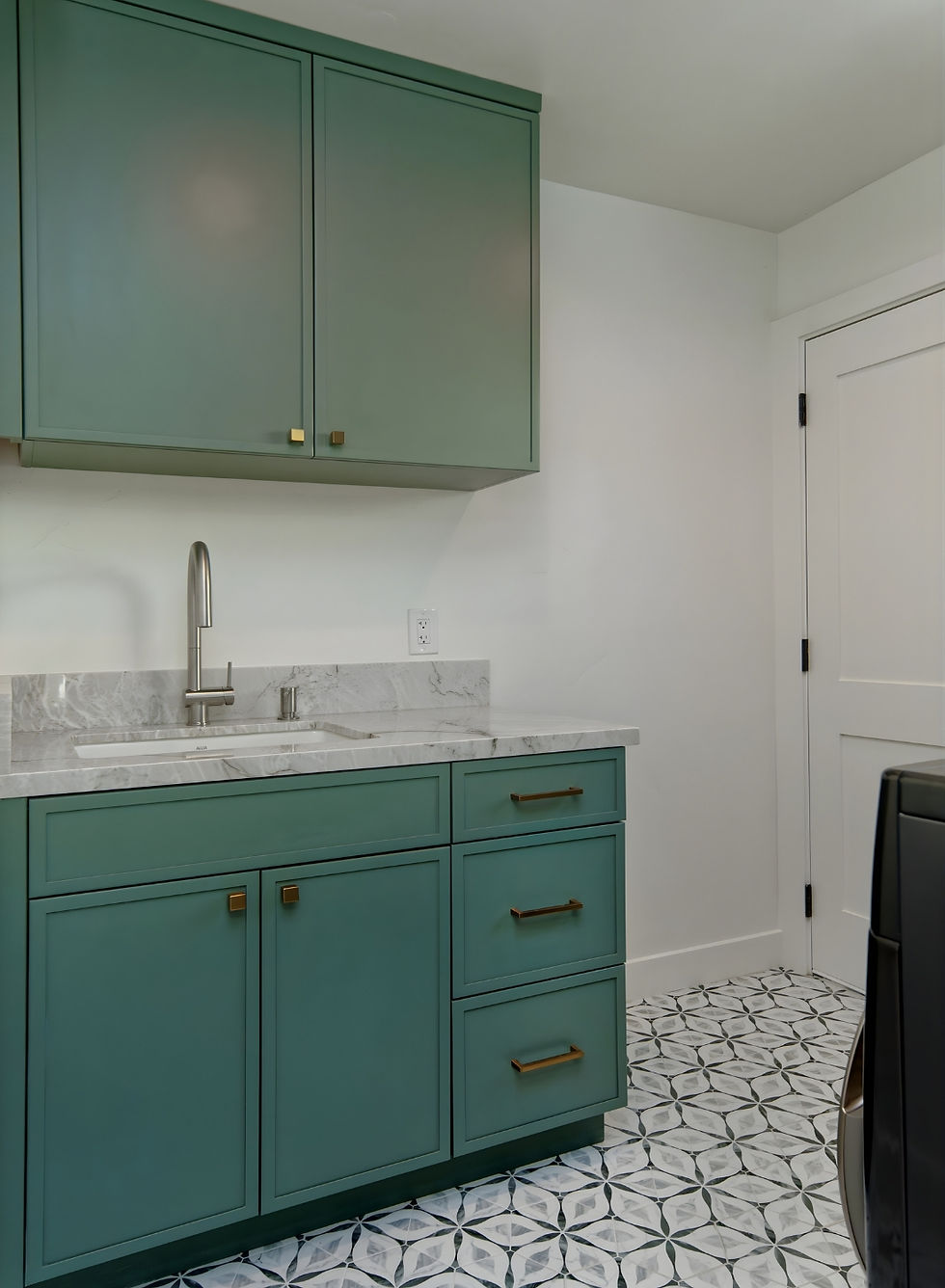
The laundry room is often the last space homeowners invest in, and the first space that dates a renovation. In this project, it received the same careful attention as every other room in the house. That is the studio's philosophy: no room is a throwaway, because every room is part of the life lived inside the home.
Forest green cabinetry in both upper and lower configurations carries the signature palette from the kitchen directly into the laundry room. Brushed gold hardware connects it back to the kitchen appliance garage. The countertop is quartzite, continuing the stone through-line. And the floor is where the room earns its own moment: a bold black and white geometric cement-look tile in a repeating diamond pattern that gives the space personality and makes it feel genuinely finished.
The result is a laundry room you don't feel the need to apologize for when guests walk past.
The Dining Room: Letting the Furniture Lead

Not every space in a well-designed home needs to be driven by architecture or tile. The dining room in this project is a demonstration of restraint and a reminder that dreams for a home do not always require maximum intervention. Sometimes the most focused design decision is knowing when to step back.
Warm white walls, the same light hardwood floors that run throughout the home, and two generous windows create a neutral backdrop that lets the furniture make the statement. A solid oak dining table with butterfly joint details and a thick, substantial top anchors the room. Upholstered dining chairs with black frames bring texture and comfort. A sculptural black chandelier with curved arms and saucer-shaped shades adds drama overhead without adding color. A faded vintage-style rug grounds the seating area and adds the warmth of age and pattern to an otherwise clean room.
This is a room designed to live in, not just to photograph.
What Bay Area Interior Design Projects Look Like From the Inside

The Process Behind the Palette
Whole-home renovations are only as successful as the initial planning that precedes them. This project involved detailed space planning across every room, material specifications documented in full elevation drawings, multiple perspective views developed before a single tile was ordered, and coordination across kitchen, bath, and finish trades throughout construction.
Here is a simplified version of how a project like this moves from concept to completion:
Initial consultation and lifestyle assessment
Space planning and floor plan development
Material selection and finish specifications
Elevation drawings and perspective renderings for client review
Contractor coordination and procurement
Construction administration and site visits
Final styling and photography

Each phase builds on the last, and skipping steps is where projects go sideways. The drawings for this project alone ran to 29 sheets, covering every wall of every room with dimensions, finish callouts, and fixture placements. Whether the studio is working on new construction or an existing residential home, that level of documentation is what keeps a project on budget, on schedule, and true to the original vision.
What to Look for in a Designer for a Project Like This
If you are considering a renovation in the Bay Area, the qualities worth prioritizing in an interior designer include:
Demonstrated experience with whole-home projects, not just individual rooms
A clear and documented design process with strong initial planning practices
Strong contractor relationships and construction knowledge
A portfolio that shows range across multiple styles and scopes, from luxury homes to more modest residential projects
Credentials such as CKD (Certified Kitchen Designer) that reflect specialized expertise
A design studio focused on functionality as much as aesthetics
For a deeper look at what separates a well-trained design eye from a general aesthetic sense, this piece on what a Bay Area interior designer actually notices is worth a read. And if you are thinking about a kitchen renovation specifically, the 2026 kitchen trends for Bay Area homes offers a useful look at where kitchen design is heading and how to make choices that will hold up over time.
According to Houzz's annual kitchen trends study, homeowners who work with a design professional report significantly higher satisfaction with their renovation outcomes than those who manage projects independently, particularly on projects involving multiple rooms or structural changes.
Did you know? The term "interior architecture" refers to the design of interior spaces with attention to structural and spatial elements, not just surface finishes. A designer trained in interior architecture thinks about how walls, openings, ceiling heights, and built-ins shape the way people experience a room, which is a fundamentally different skill set than furniture selection alone.
Frequently Asked Questions About This Remodel
How Long Does a Whole-Home Remodel Take in San Jose?
Most whole-home remodels in the Bay Area take between six months and over a year from initial design through construction completion. The design and planning phase alone, which includes space planning, material selection, drawings, and contractor coordination, typically runs two to four months before construction begins. Projects with complex custom cabinetry or specialty materials often have longer lead times.
What Is a CKD and Why Does It Matter for Kitchen Design?
CKD stands for Certified Kitchen Designer, a credential awarded by the National Kitchen and Bath Association to designers who meet specific education, experience, and examination requirements. In a kitchen renovation, a CKD brings specialized knowledge of ergonomics, workflow, cabinetry systems, appliance integration, and code requirements that goes beyond general interior design training.
How Do I Choose Between a Bold Palette and a Neutral One for My Home?
The most durable approach is usually a neutral foundation built on timeless palettes and natural materials, with strategic moments of bold color layered in, which is exactly what this Willow Glen project demonstrates. Neutral stone, flooring, and wall colors create a base that will not date quickly, while bold color in cabinetry, tile, or fixtures can be more adventurous because those elements are refreshable over time. The key is choosing the bold elements carefully and repeating them with intention rather than scattering color randomly.
What Is the Difference Between Interior Design and Interior Decorating?
Interior design encompasses space planning, interior architecture, construction coordination, and material specification in addition to aesthetics. Interior decorating focuses primarily on furnishings, accessories, and surface treatments within an existing space. For a renovation project involving cabinetry, tile, plumbing fixtures, or structural changes, you need an interior designer rather than a decorator.
Ready to Start Your Own Whole-Home Remodel?
The Willow Glen project is a reminder that great design is not about following trends or spending the most money. It is about making decisions with clarity and carrying them through with consistency, from the first material choice to the last hardware pull. It is about the creativity to see what a space could become, and the collaboration between designer and client to get it there.
If you are considering a renovation in the Bay Area and want to work with a studio that brings that same level of care and intention to every project, Spaces by Juliana Linssen would love to hear about your home. Start the conversation here and let us talk about what your space could become.


