
The Los Gatos ADU Design That Refused to Be an Afterthought

Most accessory dwelling units get the leftovers. Whatever materials didn't make the cut for the main house, whatever square footage the zoning allows, whatever budget survived the primary renovation. This Los Gatos ADU design took a different approach entirely. Every room received the same level of attention, the same quality of materials, and the same design intention as the main residence it sits beside. The result is a detached ADU that stands completely on its own terms.
California's updated ADU regulations have made it easier than ever for Bay Area property owners to add an accessory dwelling unit to a single family home. What this Los Gatos project proves is that the answer to what an ADU can be does not have to involve compromise. Small in footprint. Completely uncompromising in finish.
This ADU was designed in dialogue with the main residence kitchen and bath completed for the same clients, carrying the same elevated material standards into a fully independent living space. The two projects share material DNA without being identical, and the result is a property where the accessory dwelling unit earns its place not as an add-on, but as a continuation of a fully considered design vision.
What Does Intentional ADU Design Actually Look Like?

The question most homeowners ask when planning an ADU is how to make it feel like more than a secondary space. The answer here was straightforward: treat it like a primary residence from the very first material decision.
Green quartzite slab runs floor to ceiling through the primary bath and shower. Not tile. Not a stone-look porcelain. Actual bookmatched quartzite slab, cut from the same block and opened so the veining mirrors across the walls of the shower. The effect reads less like a bathroom and more like a geological event. Satin bronze fixtures sit against it without apology. A black soaking tub anchors the room beneath steel-framed windows that frame a dense canopy of trees outside, making the whole space feel like it exists somewhere between inside and out.
Did you know? Bookmatched stone slabs are cut from the same block and mirrored so the veining creates a symmetrical pattern across two panels. The result is a surface that reads as one continuous work rather than individual pieces, and it requires careful selection at the slab yard and precise installation to pull off correctly.
The primary bathroom is where this project announces itself most clearly, but it is not where the design story starts.
How the Kitchen Sets the Tone
A Navy Island That Earns Its Moment
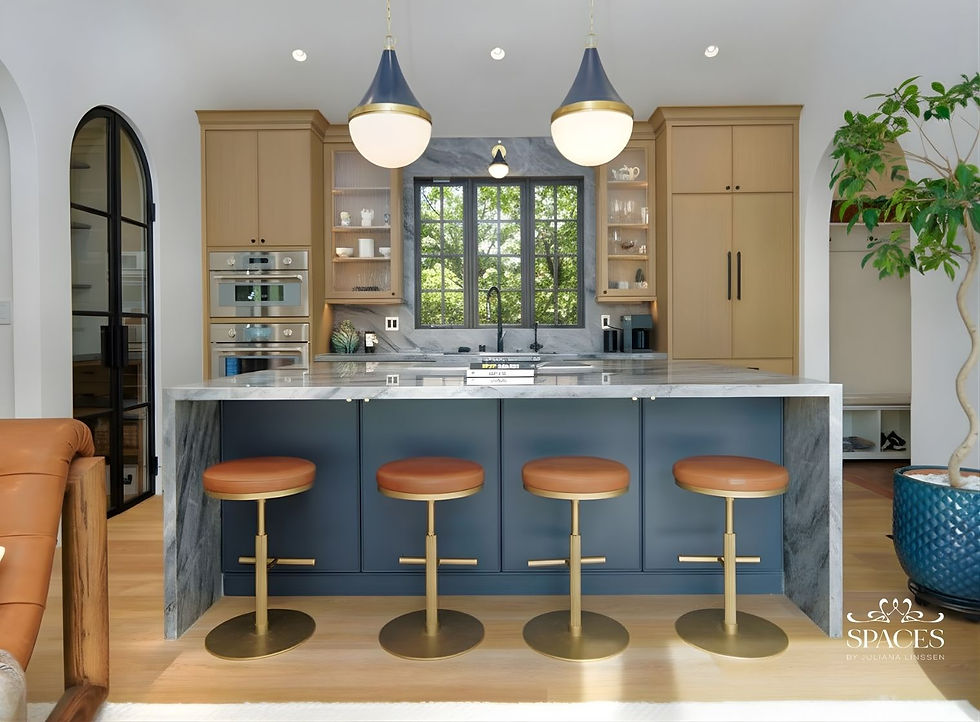
Walk into the kitchen and the first thing that registers is the island. A deep navy base with satin bronze hardware holds a waterfall slab of grey quartzite that wraps around the end panel and down to the floor. Four leather barstools with brass bases pull up to it. Navy and brass pendant lights hang above. Warm oak cabinetry lines the perimeter walls with reeded glass fronts lit from inside, and the sink wall is framed by a steel-grid window that fills the space with green from the trees outside.

The grey quartzite appears on the countertops, the backsplash, and the island waterfall, creating the same continuity of material that the green quartzite achieves in the bath. Appliances are built into the oak cabinetry with enough restraint that they read as part of the composition rather than interrupting it. Hardwood flooring runs throughout in a warm, light oak that keeps the palette grounded without competing with everything happening on the walls and surfaces.
Quick tip: Choosing one stone and running it across multiple surfaces in a single room, countertop, backsplash, and island, reads as a deliberate design move rather than a budget decision. It creates visual cohesion and makes a smaller kitchen feel more considered.
The arched steel pantry door visible from the kitchen is one of the details that ties the ADU to the broader design language of the property. Arches appear throughout, in doorways, in the steel door frames, and in the mirrors of the primary bath, creating a recurring architectural motif that gives the space a sense of identity.
Where the Kitchen Gives Way to the Living Space

The living area sits just off the kitchen, and the transition between the two is seamless. The same grey quartzite that anchors the kitchen island reappears here as a full-height feature wall, a single large-format slab that runs floor to ceiling behind the living space. Floor-to-ceiling sliding glass doors open to a private outdoor patio surrounded by mature landscaping, and sheer linen curtains filter the light without blocking the view into the trees.
The room works because it does not try to compete with what surrounds it. It is calm, warm, and grounded, a place that registers as a retreat rather than a showpiece. That continuity of material between the kitchen and the living area is what makes the open plan feel intentional rather than incidental.
For more on how restraint and intention work together across an entire home, the Willow Glen whole-home remodel shows the same approach applied at full residential scale.
The Details That Make It Work

Chevron Doors and the Logic of Consistency
One of the less obvious decisions in this project is the interior doors. Each door throughout the ADU features a chevron-patterned white oak veneer with matte black hardware. The pattern is subtle enough that it reads as texture from a distance and only reveals itself up close, but it is consistent across every door in the unit.
That kind of consistency, repeating a detail in a way that creates rhythm without becoming repetitive, is what separates a designed space from one that simply has nice materials.
The same logic applies to the satin bronze hardware that appears in both the kitchen and the bathrooms, and to the steel-framed windows and doors that appear throughout. None of these elements are accidents. Each one was chosen to reinforce a palette and a point of view that holds the whole project together.

Quick tip: When specifying hardware and fixtures across multiple rooms, choosing finishes from the same family creates cohesion even when the rooms look very different from each other. In this project, matte black and satin bronze appear in every space, keeping the palette consistent from the kitchen to the shower.
What ADU Design in the Bay Area Actually Involves

How California Zoning Regulations Changed What's Possible
California has led the country in making ADU development accessible to property owners. State law now requires most cities and counties to allow ADUs in single family zoning districts, and many of the owner occupancy requirements that once limited who could build or rent an ADU have been significantly relaxed. Building permit timelines have been streamlined, and many Bay Area cities have introduced local ADU programs with additional resources and incentives for property owners.
A detached ADU on the same lot as a primary residence can serve family members who need independent living space, generate rental income, or function as a flexible living space that changes purpose over time. The Los Gatos ADU featured here functions as a fully independent dwelling unit with its own kitchen, primary bedroom, and primary bath, a stand-alone structure with a separate entrance that also remains visually and materially connected to the main house.
Did you know? According to the California Department of Housing and Community Development, ADUs can be built in single family zoning districts without a discretionary hearing in most jurisdictions, meaning approval is largely administrative rather than subject to neighbor objection or public comment.

What to Consider Before Adding an ADU
Before beginning the design process, property owners should think through a few key factors:
Local zoning laws and setback requirements, which vary by city even within the Bay Area
Whether the project qualifies as a detached ADU, attached ADU, garage conversion, or internal ADU
Building permit requirements and any ADU program incentives offered locally
How the ADU will affect property taxes, which in California are generally reassessed only on the new construction value
Whether short term rental restrictions apply in the city where the property sits
Working with a designer before contractors or structural decisions are finalized gives the most flexibility in how the space is configured and finished.

What Are the Main ADU Types Available to Bay Area Homeowners?
Not every property suits the same approach. The main ADU types include:
Detached ADU — A stand-alone structure built separately from the existing home, as in this Los Gatos project. Offers the most independence and typically allows for the greatest design flexibility.
Attached ADU — Connected to the primary residence but with its own separate entrance. Common on properties where lot size limits placement of a detached structure.
Garage conversion — Converts existing garage space into living space. One of the more cost-effective ADU types since the structure already exists, though it must meet current building codes for habitable space.
Internal ADU — Created within the existing structure of the home, such as a converted basement or bonus room.
Junior ADU — A smaller unit, typically up to 500 square feet, created within the existing home with minimal exterior modification.
Each type comes with its own zoning regulations, building requirements, and design considerations. A garage conversion involves different structural challenges than new construction for a detached ADU. For a broader look at what full-scale renovation looks like in the Bay Area, including how to plan and what to expect from the process, What It Actually Takes to Pull Off a Bay Area Home Renovation is worth a read.
Frequently Asked Questions About ADU Design
What is an accessory dwelling unit?
An accessory dwelling unit is a secondary housing unit located on the same lot as a primary residence. It can be a detached structure, an attached addition, or a conversion of existing space such as a garage or basement. ADUs provide flexible living space for family members, rental income opportunities, or additional housing on a single family property.
How much does ADU design and construction cost in the Bay Area?
Costs vary based on ADU type, size, site conditions, and finish level. A garage conversion will cost less than new construction for a detached ADU, and a high-finish project like this Los Gatos renovation will cost more than a standard build. Getting estimates from licensed contractors early in the process, before design decisions are locked in, helps establish realistic expectations.
Do I need a building permit to build an ADU in California?
Yes. A building permit is required for all ADU construction in California, including conversions and internal ADUs. California state law requires cities to approve or deny ADU applications within 60 days, and many jurisdictions have streamlined the process. Some cities offer pre-approved ADU plans that can reduce review time and pre-development costs.
Can I rent out my ADU in California?
Yes. California state law allows property owners to rent ADUs as long-term rental housing. Short term rentals may be subject to additional local regulations. Owner occupancy requirements that previously restricted ADU rentals have been largely eliminated under current state law, though some local rules may still apply.
Does adding an ADU increase my property taxes?
In California, adding an ADU triggers reassessment only on the value of the new construction, not on the entire property. The existing home retains its current assessed value under Proposition 13, making ADU development more financially accessible than many property owners expect.
What is the difference between a detached and attached ADU?
A detached ADU is a stand-alone structure physically separate from the primary residence with its own foundation, walls, and roof. An attached ADU shares at least one wall with the main house but has its own separate entrance and living space. Both are allowed in most single family zoning districts in California under current state law.
How do I find an interior designer for an ADU project in the Bay Area?
Look for a designer with experience in both residential renovation and the regulatory environment specific to your city. Reviewing portfolio work is the most direct way to assess whether a designer's point of view aligns with yours. To learn more about the design process, visit the process page.
What This Project Says About What ADUs Can Be
The Los Gatos ADU featured here is not trying to prove a point. It is simply a well-designed home that happens to sit on the same lot as another well-designed home. The green quartzite in the shower is not an extravagance inserted to impress. It is the right material for that room, chosen because it works, and executed with the same care that every other decision in the project received.
That is what good ADU design looks like. Not a scaled-down version of something better elsewhere on the property. A space that knows exactly what it is and delivers on that completely.
To explore working on a renovation or ADU project in the Bay Area, visit the services page or reach out directly through the contact form.
ADU regulations, permit requirements, and zoning laws vary by city and county. Always verify the rules that apply to your specific property with your local planning department before beginning any ADU project.


