Lighting as Sculpture: When the Fixture Becomes the Art

In most rooms the art goes on the wall and the lighting stays quiet overhead. That order gets reversed far more often than people expect.
A decorative fixture is the only object in a house that is both furniture and light source. It hangs in the middle of the volume rather than against its edges. It is visible from every angle, from adjacent rooms, and often from the floor above. In a space with a vaulted ceiling it is frequently the largest single object in the room. Treated well, it stops being a utility and becomes the piece everything else is arranged around.
Here is how I think about choosing one.
Entries earn the biggest gesture
An entry has no sofa to study, no rug underfoot for long, no view competing for attention. Whatever hangs there carries the entire first impression. It is the one place in a house where I will spend a disproportionate share of the lighting budget without hesitation.

This entry was built for a large fixture and would have looked unfinished without one. The ceiling lifts into a barrel vault with wood planking running up the pitch, the walls are wrapped in a fine woven texture, and the doors are near black. Everything is warm but restrained. The chandelier answers with hundreds of overlapping translucent discs on a gold frame, layered in tiers so they catch light at different depths and shift as you move under them. From the door it reads as a single glowing mass. From directly beneath, it separates into individual pieces.

A hallway this narrow does not have room for width, so this fixture works vertically and by contrast instead. Dark petals radiate outward on slender brass stems, and against the pale plank ceiling and the daylight from the skylight they read almost as a botanical specimen. The wood door below is rich and grainy. The fixture stays graphic and black so the two do not compete.

Proof that a sculptural fixture does not require a soaring ceiling. This is a standard-height passage, and the brass spokes of the fixture push out in every direction to fill it. The chevron doors bring their own strong geometry, so the light stays a single color and a single idea. Nothing here is subtle, and that is deliberate.

Sculptural also does not mean modern. The doors are traditional, arched and paneled, with leaded glass sidelights. The fixture answers with two tiers of dark cascading rods that fall like rain from a slim metal frame. The silhouette is contemporary. The finish and the weight of it belong to the architecture.
Scale is the decision that goes wrong most often
Almost every fixture I am asked to replace is too small. It was chosen from a photograph, at a size that felt reasonable in the abstract, and once it was hung the room absorbed it.
The measurements I work from:
Over a dining table: a diameter of roughly half to two thirds the width of the table. Anything narrower starts to look like a pendant that lost its companions.
Hanging height over a table or island: 30 to 36 inches above the surface. Higher in a room with a very tall ceiling, since the fixture needs to stay in visual relationship to what is under it.
In an entry: at least seven feet of clearance to the floor, and if there is a landing or a window above, the fixture has to be legible from both levels. That usually means a taller fixture than the plan view suggests.
In a two-story or vaulted volume: the fixture should occupy the vertical space, not float apologetically near the peak.
When a client is torn between two sizes, the larger one is almost always correct.
A strong fixture needs the right field behind it
A sculptural light does not automatically demand a plain background. It demands a background it has an argument with.

The wall here is anything but quiet. Large-format tile in deep charcoal carries a raised starburst relief that catches the light across the whole surface. The sconces could easily have disappeared into it. Instead they repeat the geometry: three frosted cones held on splayed black arms that radiate from a square backplate, warm brass at the joints. The fixture and the wall are speaking the same language at two different scales, which is why the pairing works.

The opposite problem. These walls are enormous slabs of deep green stone with rust and cream movement running through them, and they are the loudest surface in the house. A shiny or heavily detailed fixture would have turned the room into noise. The pendant and matching sconce are black on the outside with a warm gilded interior, so they cut a clean dark silhouette against all that movement and only give up their warmth when lit. Unlacquered brass fittings tie the metals together without adding another shape, which is the whole trick to mixing metal finishes in one room: let one metal set the tone and let the second one support it.

Here the ceiling was reworked to make the fixture possible. A tray was cut and painted a warm gold so the clustered ribbed glass globes have a field to sit against and something to bounce off. The rest of the room is calm: pale floors, a freestanding tub in the bay, a glass enclosure. A chandelier over a tub is not a practical decision. It is the reason the room feels like a destination rather than a wet space.
In kitchens, repetition is the composition
Kitchens rarely get one sculptural fixture. They get a pair or a run, which means the sculpture is partly the object and partly the rhythm.

Two pendants, matched, hung high enough to clear sightlines to the window. Each has a tapered navy cone shoulder banded in brass over a full opal globe, so the shape reads as two forms stacked rather than one. They pick up the blue of the island base and the brass of the stools, which is what keeps a bold color choice from looking arbitrary. A small black and brass flush mount over the sink repeats the family without copying it.

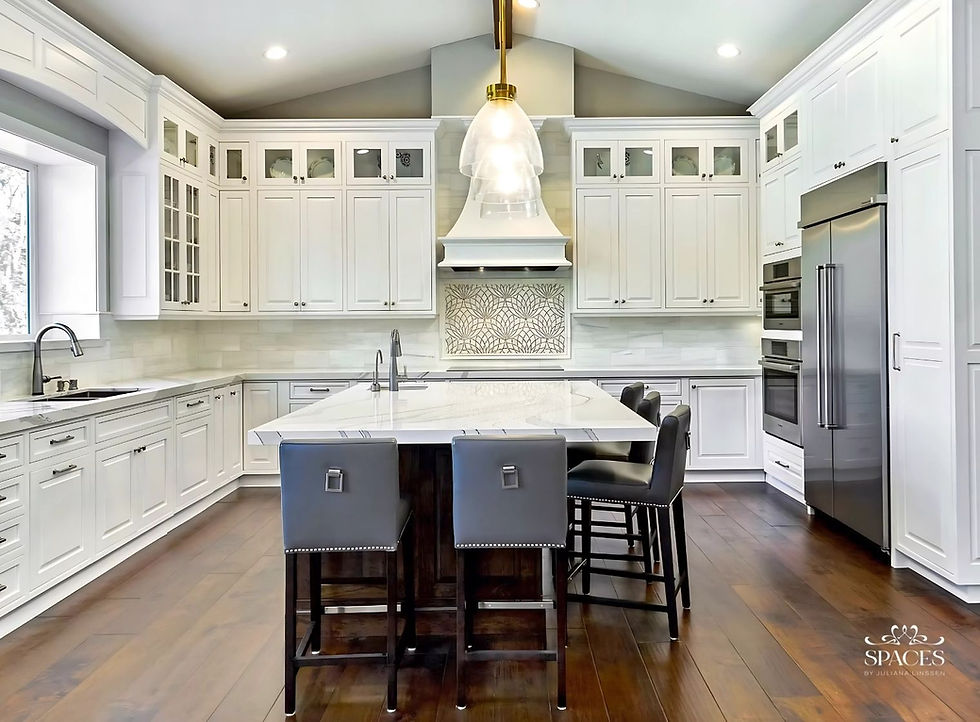
Two different fixture families in one room, which people are often warned against. It works because their jobs are clearly divided. Over the dining table, a wide cluster of clear ribbed glass globes on a brass frame, soft and expansive, filling the vault. Over the island, two black cone pendants, tight and directional, sized to disappear when you look past them to the hood. One fixture is the sculpture. The other is the punctuation. If both had tried to be the sculpture, the room would have felt crowded.
Before you commit to a fixture
Five things worth confirming while it is still returnable:
Dimming. A sculptural fixture at full output is usually unpleasant. Confirm the driver or bulbs are compatible with the dimmer being installed.
Weight and blocking. Large fixtures need structural support in the ceiling, and that has to be planned before drywall closes.
Bulb visibility. Exposed glass means the bulb shape and color temperature are part of the design, not an afterthought.
Servicing. If it sits over a tub, a stairwell, or a 20 foot vault, decide now how it will be cleaned and relamped.
Energy code. California requirements affect fixture and control selection more than most homeowners expect. Worth checking against the spec before ordering.
The takeaway
A fixture is the fastest way to give a room a point of view, and one of the hardest things to change later once ceilings are patched and circuits are set. It deserves to be decided early, at the same table where the floor plan is decided, not chosen at the end from what is available.
If you are planning a project in the greater Bay Area and want lighting treated as part of the architecture rather than a finishing touch, book your consultation.